
As cyclists we know our sport has inherent risks. Narrow roads, distracted or aggressive motorists, loose dogs, flat tires, bad weather and poor surface conditions are hazards we accept to be able to ride. In addition, riding side by side to talk or turning around to have a yelled conversation with someone behind us make our beloved pastime even less safe.
The perils of pedaling made us early adopters of cycling intercoms. We had a tandem, so we invested in a pair of headsets wired together which worked great until we got off the bike. Then we’d have to disconnect from each other and reconnect when we got back on the bike. Nonetheless, they served their intended purpose well. We could talk in a normal voice and not turn our heads to hear, thus keeping our eyes safely on the road.
We still didn’t have a communication solution for when we rode our single bikes, but we didn’t ride them that often since we were usually on the tandem, so the wired-together headsets were fine. That changed in 2017 when a car ran a red light at an intersection and hit our tandem as we were crossing. The wreck sent Kelly to the ER in an ambulance, and our tandem was totaled.
Tandem-less for the next several months, we were back to riding our single bikes. We really missed being able to communicate while we were riding, plus we realized how much more precarious it felt when we couldn’t easily talk to each other. If one of us got too far in front or behind we couldn’t easily find each other, and if one of us got stuck at a red light, the other rider often didn’t realize it and the gap widened. So we began our hunt for a wireless intercom system. While motorcyclists had a lot of choices, there were almost none for bike riders. A motorcycle intercom mounts inside the helmet and puts the speaker/intercom right up against the ear. Since bicyclists don’t generally wear helmets that cover the ears, motorcycle intercoms can’t be adapted easily.
We finally found Terrano, a company that makes wireless intercoms specifically for cyclists. The unit itself mounts to the top of the helmet and, critically, the headset rests over the ear without completely covering it. This is important because, while you want to hear your riding partner, you also want to be able to hear traffic. X, Terrano’s first model, did a pretty good job of cancelling wind noise and had a decent battery life of about 6 hours.
A couple of years later, Terrano had a sale on their new model, the XT, so we decided to give it a try. Not only did the new version mount more easily and less conspicuously on the helmet, it also did a better job of reducing wind noise and had improved battery life. Over the next few years we did several long trips with the XT’s and were perfectly content with them. Unfortunately, in the middle of a multi-week trip in the Czech Republic and Germany, one of the units stopped charging.
Frantically researching online for alternatives, we settled on trying a model by Sena called the Pi. Sena has been in the business of motorcycle intercoms for a long time, and their bicycle model was a lot cheaper than the Terrano. We struggled through a couple of days of riding without intercoms until we could get a pair of Senas shipped to an Amazon locker in Nuremberg, Germany.
Back on the road, the Sena Pis worked really well. It was a relief to be able to have conversations, warn each other of hazards, or just point out the scenery again. Unfortunately, after only three days of riding, one of the Sena units quit working. No amount of chatting with Tech Support could get it working again.
Once again not having the ability to converse, we set out for our next destination. We made it just fine, but, until you’ve gotten used to being able to speak freely with your riding partner, it’s hard to understand how much you miss it. That first night, though, after doing some additional online research, we realized the Terrano XT that still worked could be paired with an open channel on the working Sena Pi. This helped get us the rest of the way to Munich over the course of the next few days.
Since we already had one defective Sena unit, we decided to send them both back for a refund and to deal with a replacement when we got back to the U.S. One of the things we really like about the Sena Pi was how it fastened to the helmet strap next to the ear without having to glue a unit to the helmet. This feature persuaded us to give the Sena Pi another try. The new units worked okay, but we could hear a lot of wind noise as we rode, something we hadn’t really noticed when we had the units in Europe.
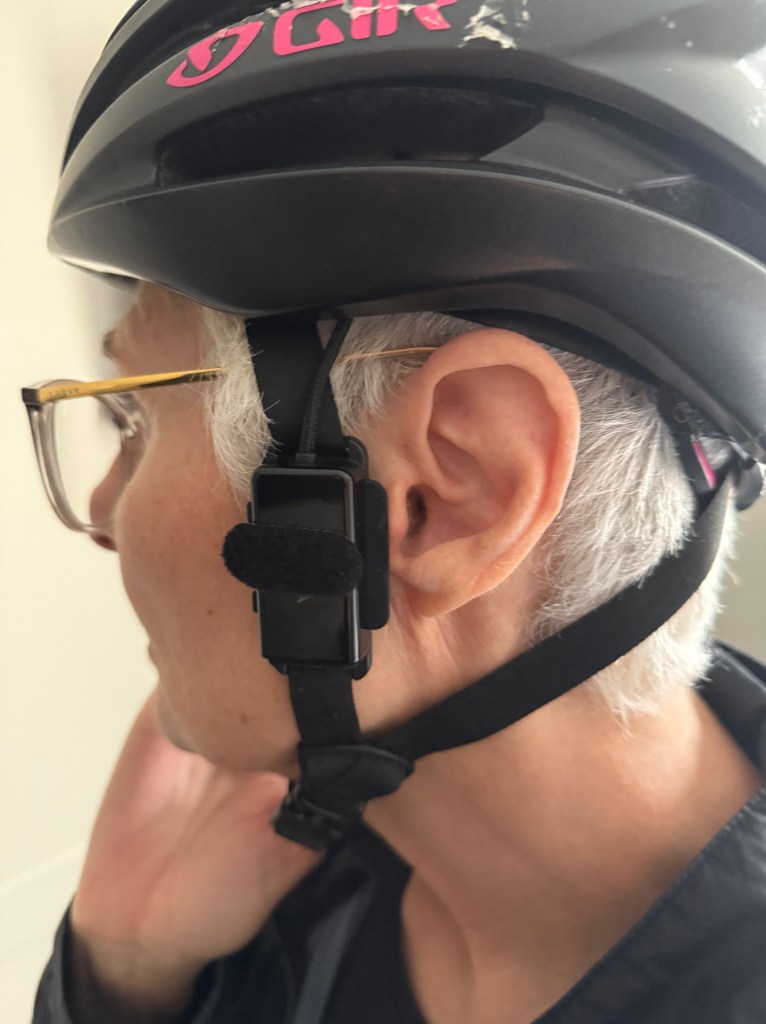
In the fall of 2025 we headed back to Germany to get our bikes from storage and move them to Paris. Because we already had bike helmets in Europe all we had to do was bring along the Sena Pi units and clip them to the helmet straps. We didn’t ride very many miles on that trip, but we discovered we were not having the same problems with wind noise as we did back home. We decided the helmet straps were at a different angle which changed how the wind passed across them, improving the Sena’s performance on those helmets.
Because we were no longer satisfied with how the Sena Pi worked on our home helmets, we decided to give Terrano’s new unit, the Q, a try. The Terrano Q has, by far, the best sound quality and wind noise reduction of any headset unit we’ve ever had. So, problem solved, right? Well, sort of. The Terrano Q, just like its predecessors, mounts on the helmet rather than on the straps. Removing them and remounting them when we headed to Europe sounded like a real pain.

In the meantime, Sena came out with a newer model, the Bikom 20. While it still mounts just to the helmet strap, this version has an adjustable microphone with a windscreen. Since finding the perfect intercom is now an obsession, we decided to give the Bikom 20 a try as well. The wind noise is definitely better than the Pi but the sound quality is not as good as the Terrano Q. Because the Bikom 20 comes on and off the helmet straps easily, we are going to take both Sena models back to Europe with us and experiment with them on our Europe helmets. The Terrano Q’s will stay mounted to our home helmets.
As of this writing we’ve been through three versions made by Terrano and two versions made by Sena. Both the pros and cons we’ve experienced are listed below. However, if we were just starting out with wireless cycling intercoms and didn’t really have to worry about portability, we would definitely choose the Terrano Q.
| Factors | Terrano Q | Sena Bikom 20 |
| Less wind noise | X | |
| Portability | X | |
| Less expensive | X | |
| Better sound quality | X | |
| Battery life | no clear winner, they are both decent | |
| After-purchase support | X | |
For many cyclists who ride regularly with a partner, a wireless intercom system may feel like an unnecessary luxury, but for us, they have become an essential piece of equipment. They’re not without quirks, but our long experience with them has made them fairly easy to use, Still, we’re always on the hunt for that next, better model with perfect acoustics and problem-free mounting system.
 Krause Travels
Leave a comment